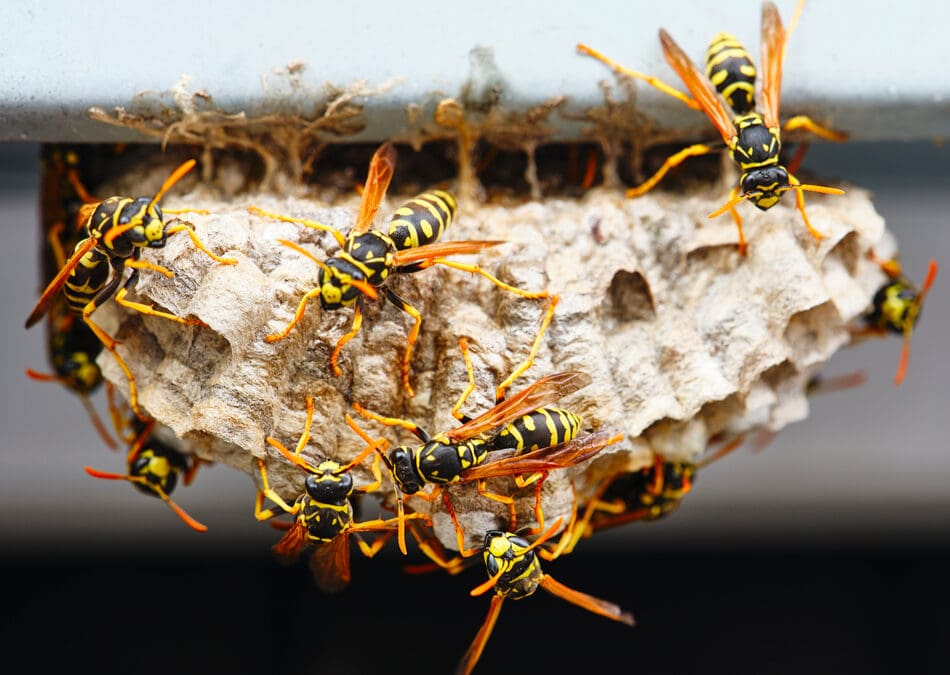
Most homeowners don’t think about hornet control until they see a football-sized nest in July. By that point, you’re dealing with an established colony of hundreds of protective workers. In Northern Virginia, warm early springs allow hornet queens to begin nesting sooner than many homeowners expect, which is why the secret to a hornet-free summer is a proactive strategy that begins while the ground is still thawing.
1. The “Queen Phase”: Why March and April Matter for Hornet Control
Every large nest you see in August started with a single queen in the spring.
The Starter Nest: In March and April, queens emerge from hibernation to build “starter nests” the size of a golf ball.
The Window of Opportunity: If you spot these small, grey spheres on your porch ceiling or eaves now, you can stop a 500-worker colony before it even begins. This early intervention window is the most cost-effective time for professional hornet control.
2. Structural Exclusion: Closing the “Voids”
European Hornets, in particular, are cavity nesters. They aren’t looking for a branch; they’re looking for a hole in your home’s “armor.”
Soffits & Siding: Inspect where your siding meets the roofline. Gaps as small as 1/4 inch are enough for a hornet to enter.
Weep Holes: Use professional-grade mesh to plug weep holes in brick without trapping moisture.
Utility Lines: Check where HVAC lines or cables enter your siding. These are “pest highways” into your wall voids and a common entry point requiring targeted hornet control solutions.
3. Landscaping Tips to Discourage Hornet Foraging
Your yard might be unintentionally inviting hornets to stay.
Fruit Management: If you have apple, pear, or peach trees, fallen fruit is a sugar magnet for hornets in late summer. Clear fallen fruit daily.
Tree Trimming: Keep branches at least 3 feet away from your roofline. This removes the “bridge” hornets use to access your eaves.
Trash Security: Use bins with tight-fitting lids. Foragers can smell meat and sugar from long distances.
4. The “Decoy Nest” Myth: Does It Work for Hornet Control?
Many homeowners ask if hanging a fake “decoy nest” provides effective hornet control.
The Reality: While some studies suggest hornets are territorial, decoys are rarely 100% effective in Northern Virginia. Real-world conditions, like the abundance of food sources in our area, often override a hornet’s instinct to avoid an “occupied” territory. Relying solely on decoys is not a reliable substitute for professional hornet control barriers.
5. Professional Solutions for a Hornet-Free Summer
At Blake’s Pest Control, our quarterly service is the backbone of long-term hornet control.
Micro-Encapsulated Treatments: We apply specialized products to the peaks, eaves, soffits, and overhangs of your home.
The Result: When a queen attempts to attach her first few strands of silk to your home, she encounters a residual barrier that discourages her from nesting.
Safety Note for Homeowners
Hornet activity increases aggression near nesting sites. Attempting to treat hornet nests without proper protective equipment or training can result in multiple stings and serious injury.
Stop the Problem Before It Starts
The most effective hornet nest is the one that never gets built. By combining homeowner maintenance with professional preventative barriers, you can reclaim your deck and yard.
Ready to get ahead of the sting? Contact Blake’s Pest Control today to discuss our seasonal hornet control plans and ensure your Northern Virginia home stays protected all year long.
 Skip to content