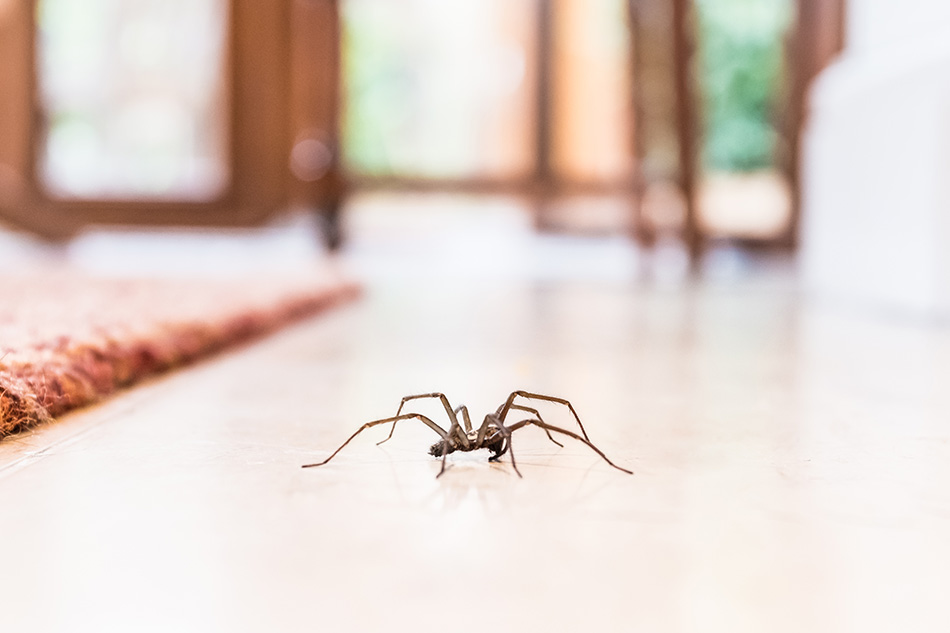
Encountering a spider inside your home can be an unsettling experience, even if you know they play an important role in the outdoor ecosystem. While most local spiders are completely harmless to humans, nobody wants to share their living room, basement, or bedroom with them.
At Blake’s Pest Control, we find that spider activity indoors is almost always tied to the presence of other insects. Simply put, if you have spiders inside, it is because they have found a reliable food source. Understanding which common spider species in Northern Virginia are invading your space can help you manage the underlying insect issues drawing them indoors.
1. Wolf Spiders (Family Lycosidae)
Wolf spiders are among the most common—and intimidating—spiders you will see in Northern Virginia. They are large, hairy, and typically grey or brown with dark stripes. Unlike many other species, wolf spiders do not spin webs to catch their prey. Instead, they are active ground hunters that rely on their incredible speed and keen eyesight.
- Where you’ll find them: Because they hunt on foot, you will usually spot them scurrying along baseboards, carpet edges, basements, and garages.
- The good news: They are robust pest controllers that eat a wide variety of crop-damaging and household insects. While their size is startling, their bite is harmless to humans and only occurs if they are actively handled or stepped on.
2. Common House Spiders (Parasteatoda tepidariorum)
As the name suggests, this is the species responsible for those classic tangled webs in the upper corners of your rooms. They are relatively small, with rounded abdomens and a dull brown or grey coloration with dark spotting.
- Where you’ll find them: They prefer quiet, undisturbed areas. You will typically find them, and their messy cobwebs, in the corners of ceilings, behind doors, under furniture, and in basements.
- The good news: House spiders are incredibly passive. If their web doesn’t catch any food, they will abandon it and spin a new one elsewhere, which is why you often find empty "ghost webs" around the house.
3. Cellar Spiders (Family Pholcidae)
Commonly referred to as "daddy long-legs," cellar spiders have extremely long, thin legs and tiny, delicate bodies. They are often confused with harvestmen (which are actually non-venomous arachnids, not true spiders), but cellar spiders are indeed true spiders that spin webs.
- Where you’ll find them: They thrive in dark, high-humidity environments. Basements, crawl spaces, under sinks, and cellars are their favorite hangouts.
- The behavior: Cellar spiders have a unique defense mechanism. When their web is disturbed, they will rapidly bounce and vibrate in place, turning into an absolute blur to confuse potential predators.
4. Grass Spiders (Agelenopsis)
Grass spiders are highly active in late summer and autumn. They are yellowish-brown with two dark stripes running down their backs. They are often mistaken for the notorious brown recluse, but grass spiders are easily distinguished by their prominent hind spinnerets (the tail-like structures they use to spin silk) and their behavior.
- Where you’ll find them: They build distinctive, sheet-like funnel webs on lawns, low-lying shrubs, and steps. During the fall, males often wander indoors looking for mates, frequently ending up in ground-floor rooms.
- The good news: They are harmless, lightning-fast runners that would much rather flee into their funnels than interact with humans.
5. Black Widow Spiders (Latrodectus mactans)
This is the only native Northern Virginia spider species of medical concern. Females are easily recognized by their shiny, jet-black bodies and the bright red, hourglass-shaped marking on the underside of their rounded abdomen.
- Where you’ll find them: Black widows absolutely hate open spaces. They build messy, incredibly strong webs in dark, cluttered, and undisturbed areas like woodpiles, cluttered garage corners, crawl spaces, and under outdoor furniture.
- What to know: Black widows are extremely shy and non-aggressive, usually biting only when squeezed or defended against a hand reaching into a dark corner. However, if you suspect a black widow infestation, it is best to let a professional handle it.
Managing Spider Activity Around Your Home
Spiders are opportunists. By making a few simple adjustments to your home's environment, you can make your property far less attractive to both spiders and the prey they hunt:
- Eliminate Indoor Clutter: Regularly decluttering storage areas, garages, and basements deprives spiders of the dark, quiet areas they prefer.
- Manage Your Outdoor Lighting: Insects are naturally drawn to porch lights and security lighting. Because spiders build webs where the food is, switching to yellow "bug lights" or motion-activated outdoor lighting will reduce insect activity right outside your doors.
- Vacuum and Sweep Corners: Routinely vacuuming up active webs, egg sacs, and wandering spiders is a highly effective way to disrupt their reproductive cycles indoors.
How Blake’s Pest Control Resolves Spider Problems
Effective spider control goes far beyond simply sweeping away active webs. At Blake’s Pest Control, we take a comprehensive approach to eliminate spiders and address the root causes of their presence.
During our service, we conduct a thorough inspection of your property to identify the specific spider species, locate their primary nesting areas, and assess their food sources. Our professional technicians then apply targeted, professional-grade treatments directly to spider hiding places and entry points to eliminate active populations and establish a protective perimeter barrier.
Because spiders are drawn to active insect populations, we focus heavily on addressing their food sources by knocking down the underlying insect issues surrounding your foundation. We will also provide practical recommendations and advice on managing environmental entry points—such as gaps or cracks in your structure—to prevent future spider access. With our reliable and proactive ongoing pest management plans, we help you keep spiders and their insect prey at bay year-round.
Ready to clear active pests away from your home? Contact Blake’s Pest Control today to schedule your customized seasonal treatment and establish total peace of mind.
 Skip to content
Recent Comments